

Créez votre livret digital avec boutique intégrée gratuitement
Créer mon livretAirbnb upsells work when they solve a guest problem that already exists.
Guests usually pay for less friction, less planning, or less uncertainty. Early check-in, late checkout, airport transfer, a breakfast basket, or a baby cot all make sense because the benefit is easy to picture.
- less friction on arrival
- less planning during the stay
- less uncertainty around practical details
The wrong offer feels different. It looks like inventory, shows up too early, and asks for attention before it has earned trust. That is why the goal is not to add more upsells. It is to make the right offers visible at the right moment.
Guests buy convenience, not inventory.
Quick filter
If the guest already asks for it, make it visible. If they do not, do not force it.
| Situation | Strong offer | Why it works |
|---|---|---|
| arrival stress | early check-in, late checkout, luggage drop-off | saves the first or last hour |
| first morning | breakfast basket, coffee refill, bottled water | removes a small errand |
| family trip | baby cot, high chair, baby kit | reduces packing |
| outdoor trip | beach kit, picnic kit, umbrella | fits the destination |
| premium stay | chef dinner, massage, celebration setup | feels like an upgrade, not a fee |
What guests actually buy
Guests do not think in operations language. They think in outcomes.
Late checkout is not a line item. It is a slower morning. Airport transfer is not transport. It is one less thing after a long trip. A baby cot is not equipment. It is less packing and less stress.
That is why the better question is not "What can I sell?" The better question is "What are guests already trying to solve when they ask me for help?" Once you answer that, the offer becomes easier to name, easier to price, and easier to place.
Weak upsells are usually framed around the host's inventory instead of the guest's situation. Strong upsells feel like relief at the exact moment it is useful.
If you want the offer to feel natural, use the guest's own language. Say "stay until 1 p.m." instead of "departure flexibility." Say "parking reserved for your stay" instead of "premium parking option." The more concrete the wording, the more it feels like part of the stay.
What actually converts
The guest is not buying a room add-on. They are buying a calmer arrival, a simpler morning, or one less errand.
How to choose the first extras
The best first extras are usually already visible in guest messages.
If the same request appears again and again, you are not looking at a random question. You are looking at demand that has not been structured yet.
The first filter is operational. The extra should be easy to explain, easy to fulfill, and tied to a moment the guest already understands. If it needs custom coordination every time, it is not really an upsell yet.
The second filter is editorial. A short list of relevant extras converts better than a long list of weak ones. A crowded menu rarely looks richer. It usually looks less curated and less trustworthy.
Use a first pass like this:
- 1.Pick the extras guests already ask for.
- 2.Keep only the ones you can deliver reliably.
- 3.Put them where the guest naturally expects to find them.
If you want the selling flow to stay clean, keep the visible offers inside a services store. That usually makes the difference between a useful offer and a page that starts to feel like a catalog.
Arrival and mobility
Arrival extras are usually the easiest to monetize because the friction is obvious.
When people are tired, carrying luggage, or trying to find the door, convenience becomes valuable quickly. Early check-in, late checkout, luggage drop-off, luggage storage, airport transfer, station pickup, reserved parking, EV charging access, grocery pre-stock, and a fridge starter pack all belong in this category.
The mistake is to overcomplicate the language. "Stay until 1 p.m." is clearer than "flexible departure option." "Reserved parking for your stay" is clearer than "additional amenity." Guests do not want to decode the wording.
What they want to know is simple: does this make arrival easier or not?
If arrival details are already centralized in a guest QR code flow, these extras become easier to present calmly. They show up where the need already exists, which is often why they feel natural to buy.
Comfort and consumables
The second cluster is about small comforts that matter more than they sound like they should.
Breakfast basket, coffee capsule refill, tea and hot chocolate, bottled water and drinks, toiletries refill, extra towels, extra bed linen, mid-stay cleaning, laundry service, and detergent pack all work for the same reason: they remove tiny tasks.
These extras tend to convert well in stays longer than one night, in properties with late arrivals, and in homes where guests would otherwise need a quick shop. They are also good because they are easy to explain and easy to fulfill. The guest understands the benefit immediately.
Simple test
If the guest can understand the benefit in one glance, the offer is usually strong enough to test.
That matters because this category does not ask the guest to imagine very much. A basket is breakfast without leaving the home. A refill is one less supermarket stop. A laundry service is more time back in the trip. The value is visible almost right away.
If your bigger goal is to increase revenue without pushing the nightly rate, this is the same logic behind revenue per booking without raising your nightly rate. The point is not to invent extras. It is to make familiar conveniences easy to buy at the right moment.
Family, outdoor, and practical gear
Some extras work because different guest types need different forms of help.
A baby cot, high chair, baby bath, or baby kit can reduce packing stress for families. A pet kit can remove a few forgotten details for travelers with animals. A beach kit, picnic kit, BBQ kit, cooler bag, umbrella or rain kit, and power adapter or charger kit can all make the guest feel better prepared.
This category usually works best when the offers are clearly tied to the stay:
- baby items for family stays
- beach gear for coastal properties
- chargers and umbrellas for city apartments
- picnic or BBQ kits for outdoor-heavy stays
The mistake is to make this category too broad. You do not need to offer everything. You only need to offer the items that fit your property and the kind of stay you actually host.
A beach apartment can justify beach gear. A family villa can justify baby items. A city apartment can justify chargers, adapters, and umbrella kits. The best offers feel local and specific.
That is the useful distinction here: the guest is not buying a random extra. They are buying an easier version of the trip they already planned.
Premium and partner services
The last cluster is more premium and usually works best when the delivery is already reliable.
Private chef dinner, in-home massage, celebration setup, bike rental, e-bike or scooter rental, restaurant reservation help, and guided local activity booking can all feel strong when the destination supports them and the fulfillment is well controlled.
In practice, that usually means:
- one clear partner
- one clear delivery rule
- one clear guest benefit
- no messy back-and-forth after purchase
The risk is not really the price. The risk is the mess. If the delivery depends on too many moving parts, the offer stops feeling premium and starts feeling fragile.
That is why this category only works when the experience feels smooth from the guest side.
If you want these offers to feel coherent instead of bolted on, keep them inside the same services store. Premium extras perform better when they look chosen and curated, not improvised.
What to avoid
The most common mistake is to turn upsells into a catalog.
Once the guest sees too many unrelated items, the menu stops feeling curated and starts feeling like a shop. That is not just a conversion issue. It is the moment the guest starts distrusting the offer.
The second mistake is to sell before the guest has context. Early in the booking flow, the guest is still deciding whether the stay itself is a fit. They are not ready for ten optional extras.
The better moment is after the booking, in the guidebook, or in the section where the relevant need appears. That way the offer feels timely instead of intrusive.
Common mistakes here are usually simple:
- too many extras on one page
- vague naming
- unclear availability conditions
- premium services without reliable delivery
If you want the presentation format behind that logic, the digital guidebook vs guest app vs PDF article shows why information structure matters when the goal is to keep the experience simple, calm, and easy to reopen.
Where the offer should live
The best place for these extras is not a back-and-forth message thread.
It is one place the guest can reopen when they need it. That is why a digital guest guidebook paired with a services store works so well. The guidebook gives the context. The store gives the optional extra.
The contrast is operationally important. In a message thread, the extra is scattered. In a structured guest flow, the extra sits next to the moment that creates the need.
That is usually what makes the offer feel helpful instead of distracting.
If your bigger problem is repeated guest questions, the article on Airbnb host messages you should stop repeating is the natural companion. The same message patterns that create operational noise often reveal the clearest service opportunities.
Final takeaway
The best Airbnb upsells are the ones guests already understand, already need, or already ask for.
If an extra saves time, reduces friction, or makes the trip feel smoother, it has a chance to convert without annoying anyone. If it feels random, it probably should not be there.
That does not mean every useful extra should be sold. Some should stay free, some should be bundled, and some should be removed.
The important distinction is simpler than it sounds: a good upsell makes the stay easier. A bad upsell makes the page heavier.
The best ones usually do the first without creating the second.
Want a calmer departure day?
You can schedule a 1PM late checkout via the digital guidebook, here is the link: [Link]
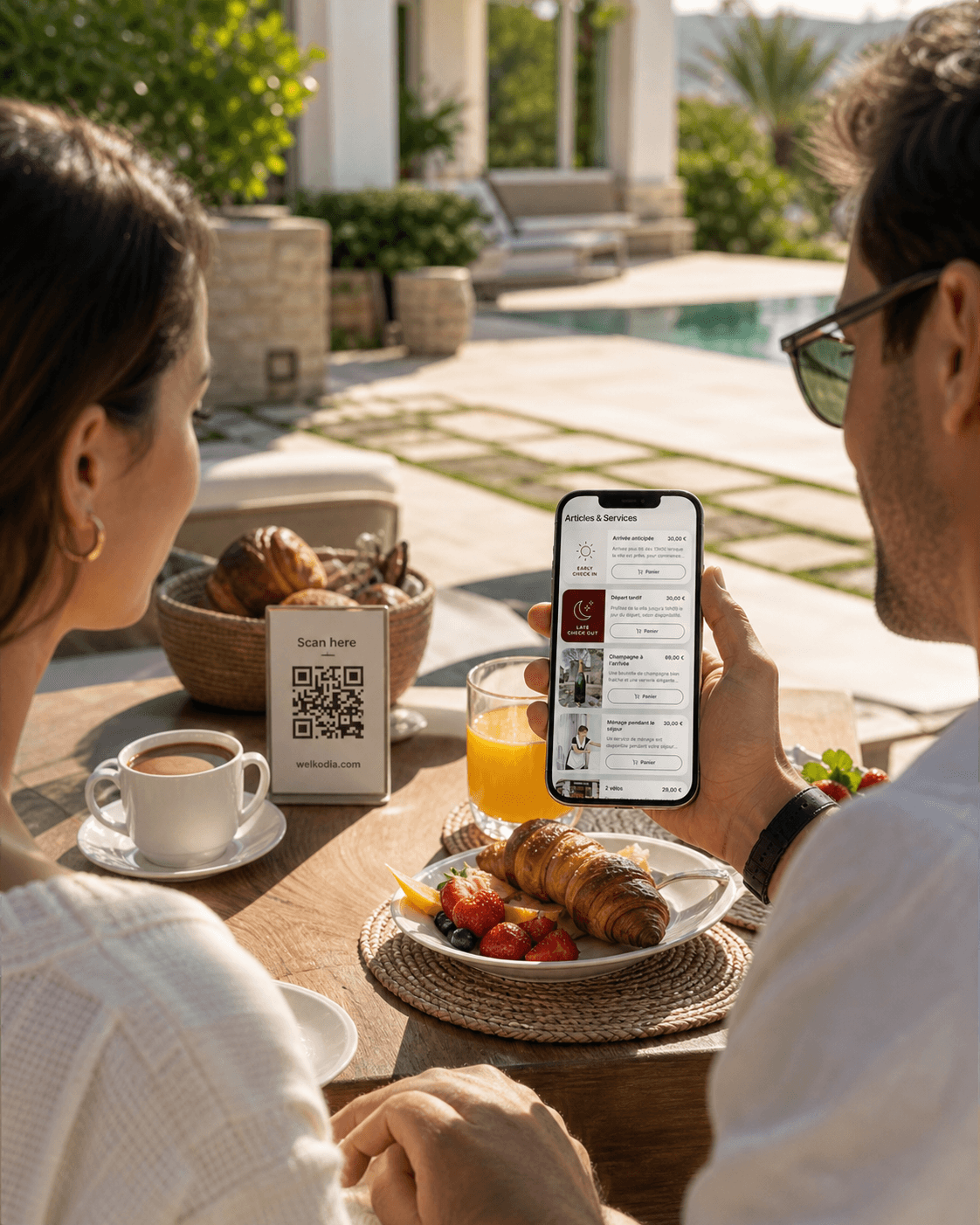
Transformez les demandes habituelles de vos voyageurs en upsells
Présentez arrivée anticipée, départ tardif, kits, transferts et services locaux dans le parcours voyageur.