

Create your digital guidebook with upsell store
Create my guidebook ->A guest asks for a late checkout at 9:45 AM. Their train doesn't leave for four hours, and they are dreading the prospect of wandering around town with three suitcases.
You have no arrival today, so the room will be empty anyway. You have three choices: say no and leave the guest frustrated, say yes for free and leave money on the table, or offer a structured, paid late checkout that makes everyone happy.
Increasing revenue per booking does not always mean raising your nightly rate. In fact, in a crowded short-term rental market, pushing your base price too high can actually hurt you by making your listing less competitive in search results.
The smarter move is to keep your nightly rate sharp and capture extra value through convenience. Guests aren't looking for random upsells; they are looking for solutions to the small, stressful moments of travel.
Quick Answer: You can make more money per booking by selling extras that save the guest time or packing space. Offer early check-in, late checkout, a stocked fridge upon arrival, or a mid-stay clean so guests can return to fresh towels.
The problem with only raising the nightly rate
Raising your nightly rate is the obvious lever because it is simple. You change the price, click publish, and wait.
But there is a hidden cost to this simplicity. Your nightly rate is the first thing a potential guest sees. If your property is already priced near its market ceiling, pushing it further can lead to a "blunt force" rejection. The guest doesn't even click on your listing to see your beautiful interior or read your 5-star reviews.
By focusing only on the nightly rate, you are competing on a single dimension: the price of sleep.
The stronger question is: "Where is the guest already willing to pay for less friction?"
The operator's shift
Successful operators stop thinking about "how to charge more for the night" and start thinking about how to capture the value of the moments surrounding the night.
The best short-term rental upsells solve timing problems
The most effective add-on services are rarely flashy or complex. They usually solve a simple timing problem: the guest arrives too early, leaves too late, or lands hungry.
When a guest pays for an extra service, they aren't just buying an "item." They are buying access to a better version of their trip.
The "Slower Morning" (Late Checkout)
Late checkout is arguably the cleanest service to test. The value is immediate and obvious.
For the guest, the difference between leaving at 10 AM and 1 PM is the difference between a rushed packing session and a calm final breakfast. If they have a late flight or train, those three hours are incredibly valuable.
The operational rule here is simple: same-day arrivals always take priority. By framing the offer as subject to availability, you protect your cleaning schedule while still capturing the revenue when the calendar allows it.
The "Landing Softly" (Early Check-in)
Early check-in works for the same reason, but at the start of the trip. Guests who have spent hours in a car or on a plane don't want a "perk"—they want a shower, a place to drop their bags, and a moment of rest.
If your cleaning team finishes early or the property was empty the night before, an early check-in is "found money." It costs you almost nothing in overhead but provides massive relief to the guest.
The approval loop
To keep your operations smooth, always use a request-based system.
- 1.Guest sees the option in your guidebook.
- 2.Guest sends a request.
- 3.You (or your team) confirm if the cleaning schedule allows it.
- 4.Payment is handled automatically.
What guests are really buying (The Framing Rule)
Guests do not usually think in the same categories as hosts. You see a "Firewood Bundle." The guest sees "one less trip to the store." You see a "Breakfast Basket." The guest sees "not having to find a grocery store at 8 AM."
This distinction matters because the way you name and describe your services determines whether they feel like a helpful convenience or a pushy fee.
Compare these two ways of presenting the same services:
| Weak wording (The "Fee" style) | Stronger wording (The "Benefit" style) |
|---|---|
| Late checkout: $30 | Stay until 1 PM and enjoy a slower departure morning. |
| Mid-stay clean: $60 | Return to fresh towels and a tidy space halfway through your trip. |
| Grocery starter: $45 | Land softly with a stocked fridge so you don't have to shop on night one. |
The stronger wording is concrete. it connects the service to the guest's lived experience.
Practical kits: Removing the packing burden
Beyond timing, the next layer of revenue comes from "kits." These are pre-assembled groups of items that solve a specific problem.
The key is not to build a massive catalog. You only need 2 or 3 kits that match your property type.
For city apartments: A breakfast basket or a "romance kit" (wine, local chocolate, late checkout). For beach houses: A "beach pack" (towels, cooler, sun cream) or a barbecue kit. For family villas:* A barbecue kit or a "grocery starter" (milk, eggs, bread, coffee).
Simple selection rule
If a service saves the guest a trip to the store or lets them leave a suitcase at home, it is worth offering.
How to choose your first services: The Inbox Audit
Don't guess what your guests want. The data is already sitting in your message history.
Your best add-on ideas are the questions you have to answer manually every week. If guests are repeatedly asking for the same thing, they are signaling unmet demand.
The 30-minute revenue audit
- 1Review the last 20 guest conversations in your inbox.
- 2List every request that isn't about the standard stay (early arrival, baggage storage, extra linens, etc.).
- 3Circle the 3 most common requests that your operations can handle reliably.
- 4Give each one a name, a price, and a clear benefit statement.
By structuring these requests as paid services, you don't just increase revenue—you also reduce repetitive manual messaging. Instead of negotiating a late checkout over five messages, you point the guest to your services store where they can see the price and confirm the request in one click.
Where to present paid services without sounding pushy
Most upsells fail because they are presented at the wrong time or in the wrong place.
If you push services the moment a guest books, it can feel aggressive. If you wait until they arrive, it might be too late for them to plan.
The better placement is inside a useful guest flow. A digital guest guidebook is the perfect home for these offers because guests are already consulting it for the Wi-Fi password, house rules, and arrival details.
When your services live alongside your helpful recommendations, they feel like a natural part of the hospitality experience.
Leaving a bit later?
You can schedule a 1PM late checkout via the digital guidebook, here is the link: [Link]
Moving from Host to Operator
Increasing revenue per booking without raising your nightly rate is a sign of a professional operator. It shows that you understand your guest's journey and are willing to provide solutions for their pain points.
Summary of the playbook:
- 1.Pick 2-3 "convenience" services (Late checkout is the best starter).
- 2.Write descriptions that focus on the benefit (Less stress, travel lighter).
- 3.Use a request-based system to protect your operations.
- 4.Place the offers in your digital guidebook so they are visible but not pushy.
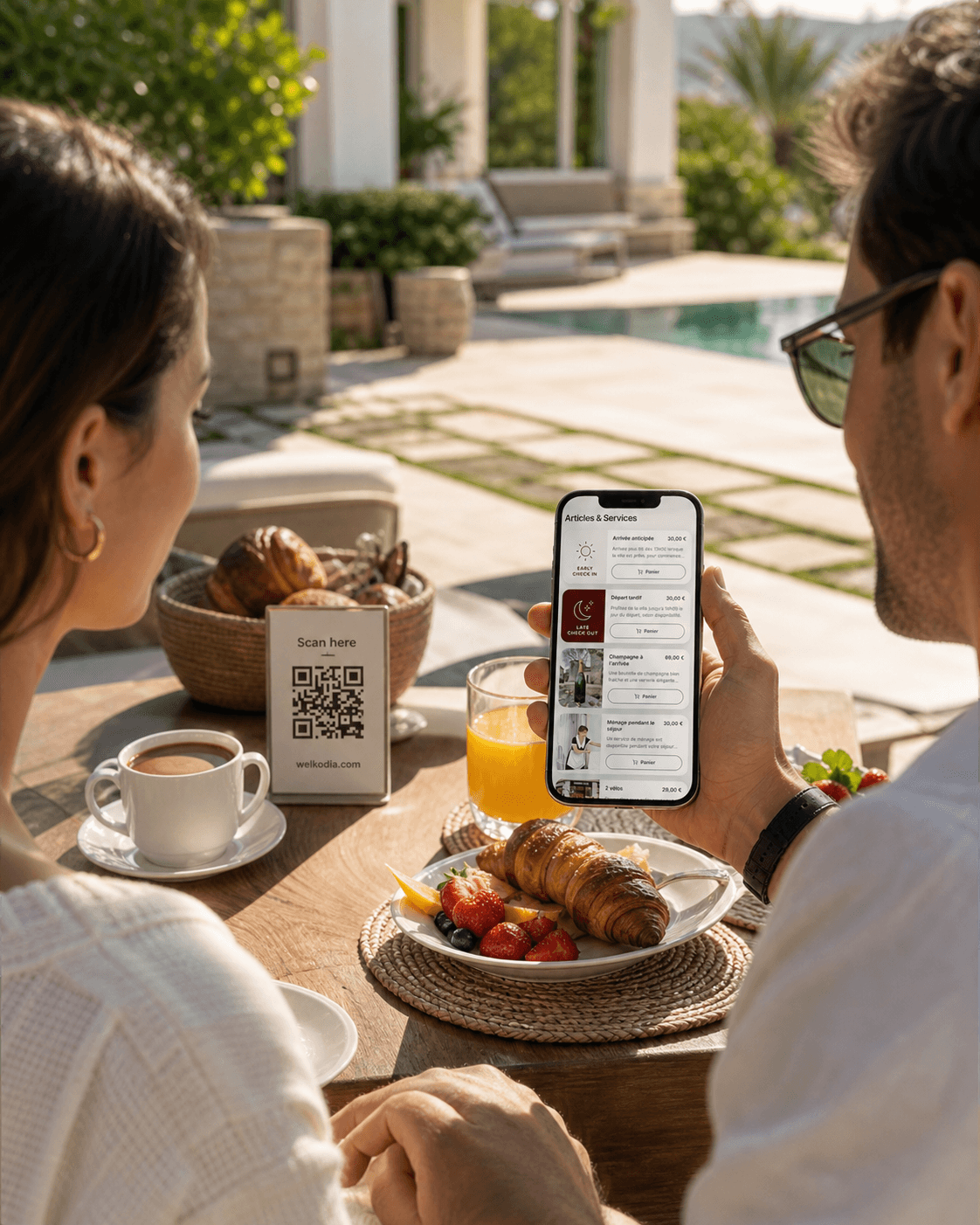
Turn usual guest requests into clear upsells
Present early check-in, late checkout, kits, transfers, and local services inside the guest journey.
When the offer is useful, visible, and easy to request, guests don't experience it as a sales pitch. They experience it as a smoother, more premium stay.
And for you, it's the difference between a standard reservation and a highly profitable one.
FAQ
Is raising the nightly rate always the best way to grow revenue?
No. The article argues that raising the nightly rate can hurt competitiveness, while convenience extras can capture value more selectively.
What are guests really buying when they purchase an extra?
They are buying a smoother version of the trip, such as a calmer departure, softer arrival, or one less errand.
What is the best first add-on to test?
Late checkout is presented here as the cleanest starter because the value is immediate and the rule can stay simple.
How should hosts find their first paid services?
Review recent guest conversations, list repeated requests, and turn the most common reliable ones into named offers with a price and clear benefit.
Where should these services be presented?
Inside a useful guest flow. The article recommends a digital guidebook because guests already open it for practical stay information.
How many kits or services does a property usually need first?
Usually only a small set. The article suggests 2 or 3 kits matched to the property type rather than a huge catalog.