

Create your digital guidebook with upsell store
Create my guidebook ->Self check-in is a good idea only when guests can actually arrive, enter, and settle in without calling you. If access, parking, the right door, or the Wi-Fi still creates confusion, you have not removed friction; you have moved it into your phone.
That is why self check-in can be either a real time saver or a source of problems.
On paper, self check-in looks like a great idea.
You do not need to be there in person. You do not have to rush across town for a late arrival. You do not need to block your evening "just in case they end up getting in at 10:40 p.m." For many hosts, it has become almost essential.
But in real operations, self check-in is not always the magical time saver people imagine.
If the guest cannot find the right door, cannot open the lockbox, parks in the wrong place, or calls you at midnight to ask for the Wi-Fi password, that is not really self check-in. It is just check-in moved into your phone.
The real question is not whether self check-in is a good idea.
The real question is this: is it clear enough to actually work without you?
Quick Answer: Self check-in only works if the guest can get from their car to inside the property without asking you a single question. Provide photos of the parking spot, a video of the lockbox, the exact door code, and emergency contact numbers in one digital link they can open offline.
Why so many hosts move to self check-in
The answer is simple: it is practical.
When the setup is solid, the experience can be excellent. Guests arrive when they need to, get into the property smoothly, settle in quietly, and everyone wins.
The issue is the condition hidden in that sentence: when the setup is solid.
In short-term rentals, small ambiguities become big operational problems very quickly.
Why it feels so attractive
Self check-in removes daily friction when the arrival flow is genuinely structured.
- handle late arrivals with less stress
- avoid rigid handover timing
- simplify operations across multiple properties
- reduce unnecessary travel
- make delegation easier for property manager teams or helpers
Where self check-in starts to break
Self check-in almost never fails because the principle is bad.
It fails because of details.
And in hosting, details are everywhere: the correct gate, the exact building entrance, the key code, the parking note, the right photo, the floor number, the dark street with three similar doors.
The details that derail arrivals
As soon as one link in the chain is unclear, autonomy disappears and support lands back on your phone.
- the code sent is not the right one
- the lockbox is hard to open
- the building entrance is not the one the guest expects
- parking is explained badly
- access photos are not clear enough
- the property sits on a dark street with several similar gates
- Wi-Fi is not visible once inside
- the guest did not read the right message
- or they are trying to find it inside a long thread at the worst possible moment
The real problem: scattered information
Many hosts still run arrivals like this:
- one Airbnb message for arrival time
- another for the code
- a WhatsApp photo for the entrance
- a text message about the gate
- a paper note in the property for Wi-Fi
- another message the next day for house rules
From the host side, that can feel reasonable.
From the guest side, it is often confusing.
When someone arrives tired, maybe late, maybe with luggage, maybe with children, they do not want to go hunting for information. They want to find it quickly.
That is where self check-in either works beautifully or turns into support work.
What guests actually need before arrival
To make self check-in work well, you need to stop thinking, "I already sent the details," and start thinking, "Can they understand everything in 30 seconds?"
In practice, guests should be able to recover six key blocks of information easily:
The 6 arrival essentials
When these are clear, self check-in becomes dramatically smoother.
- property access: exact address, building, floor, door, gate, and useful visual landmarks
- arrival instructions: where the key is, how to open the box, which code to use, and from what time entry is allowed
- parking: where to park, what to avoid, and what paid alternatives exist nearby
- Wi-Fi: network name, password, and where to find it again without digging
- important rules: noise, neighbors, smoking, pets, trash, and departure basics
- useful contacts: who to call if the gate does not open, the key sticks, or something genuinely blocks access
Self check-in works best when it reassures people
This part is often underestimated.
Guests do not just need instructions. They need reassurance.
When everything is clear, visual, and easy to scan, arrival feels smooth. Guests feel expected. They feel the property is well run. When things are vague, anxiety starts immediately.
And the more arrival stress you create, the easier it is to lose the first impression even in a very good property.
What vagueness creates
Self check-in only feels efficient when it reduces stress instead of moving it.
- "Am I at the right place?"
- "Which box is it exactly?"
- "The code is not working..."
- "What am I supposed to do now?"
- unnecessary messages
- late calls
- a weak first impression
- softer reviews because the stay started badly
How to stop self check-in from turning against you
The best response is not to send more messages.
It is to structure the information better.
Guests do not want six separate explanations. They want one clear place to reopen when they need it. That is exactly where a digital guest guidebook becomes valuable.
And that is also where you start to feel the difference between a makeshift self check-in setup and a genuinely professional one.
What should live together
Everything needed for arrival should sit in one mobile-friendly support.
- property access
- arrival instructions
- parking
- Wi-Fi
- important rules
- useful contacts
The digital guidebook is the real complement
Self check-in without a clear support layer is a little like letting someone into a place they do not know and hoping it all goes smoothly.
Sometimes it does.
Sometimes it ends with a call at 11:17 p.m.
A digital guest guidebook reduces that gray zone. Guests have one stable reference point. They know where to click. They know where to reopen the answer. And you stop rebuilding the same arrival conversation every time.
This is also why a guest QR code fits so naturally into the flow: it lets the guest reopen the right information at the right physical moment without depending on a lost message thread.
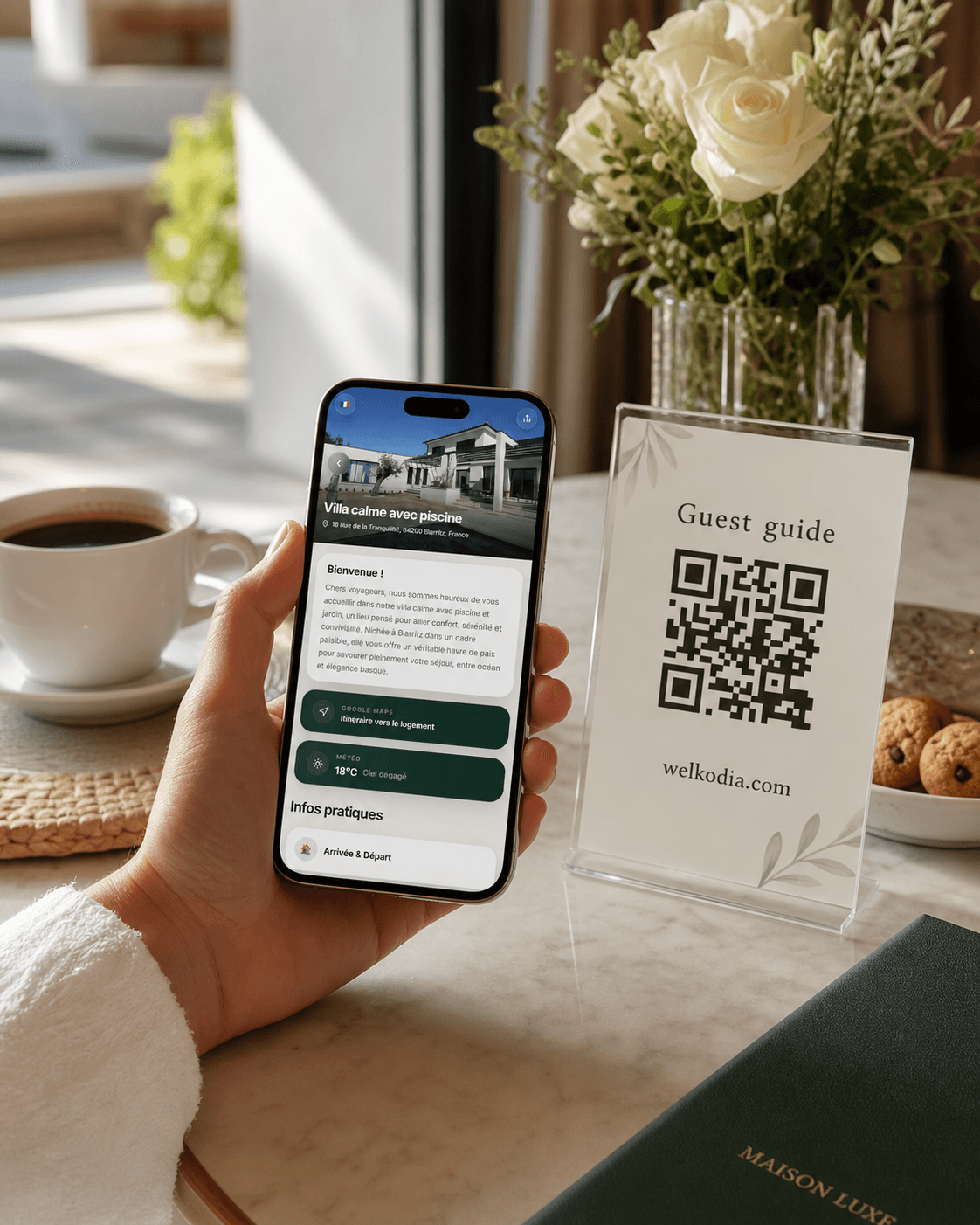
Offer your guests the opportunity to purchase your add-ons
Create a digital guidebook with arrival instructions, Wi-Fi, house rules, local tips, and optional services.
So, smart move or source of problems?
The honest answer is: it can be both.
Yes, self check-in is a very good idea.
But only when it is designed as a real arrival experience, not simply as a way to avoid being present.
If you replace your presence with vague information, scattered messages, and approximate instructions, you create more problems than you solve.
If you replace your presence with something clear, calm, and reassuring, then self check-in becomes a real lever for comfort, time savings, and more professional operations.
- more comfort for the guest
- less arrival stress
- fewer unnecessary calls
- a more professional experience
The real secret
The secret is not the lockbox.
It is the quality of the information surrounding the arrival.
That is often the exact difference between a stay that starts smoothly and a guest who calls before they have even put their bag down.
FAQ
Why do so many hosts move to self check-in?
Because it can reduce travel, simplify late arrivals, and make delegation easier when the setup is genuinely solid.
Why does self check-in still fail so often?
It usually fails on details such as unclear access photos, parking confusion, the wrong code, or guests trying to find scattered information at the worst moment.
What information do guests need most before arrival?
The article lists six essentials: property access, arrival instructions, parking, Wi-Fi, important rules, and useful contacts.
What is the core operational problem behind weak self check-in?
Scattered information. Hosts may send pieces across Airbnb, WhatsApp, text, and paper notes instead of one stable support layer.
Why is reassurance such a big part of self check-in?
Because guests do not just need instructions. They need to feel certain they are at the right place and can recover if something blocks entry.
What is the real complement to self check-in?
A mobile-friendly digital guidebook, optionally reopened through a guest QR code, so arrival information stays easy to find at the right physical moment.