

Create your digital guidebook with upsell store
Create my guidebook ->A guest asks for late checkout the night before departure. You say yes, check with the cleaner, then realize later that you never charged for it.
That is how small upsell revenue usually gets lost. Not because guests refuse extras, but because the offer lives inside improvised messages.
If you want to add around $200 per month from one property, you usually do not need luxury services or a property manager team. You need 3 to 5 useful paid extras that guests already understand, shown at the right moment, with clear rules and a clean way to request them. It is a practical planning target, not a guaranteed result.
Quick Answer: To make an extra $200 a month, sell solutions to common travel problems. Offer a $25 early check-in, a $20 late checkout, or a $15 mid-stay towel refresh. Put these options in a digital guidebook so guests can click a button to buy them without messaging you first.
| Offer type | Why it works | Common failure |
|---|---|---|
| Late checkout or early check-in | solves obvious timing stress | handled as a one-off favor |
| Private Yoga session | provides convenient on-site wellness | handled as a vague recommendation |
| Parking or luggage help | reduces arrival uncertainty | only mentioned after the guest asks |
| Transfer or local partner service | saves effort before arrival | vague process and unclear commission |
| Welcome basket or first-night add-on | makes the first hours easier | low visibility or weak margin |
The money is often already in the guest questions
Many hosts think upsells mean "selling more things."
That is usually the wrong frame.
A small property does not need a full service catalogue. It needs a few offers tied to requests that already happen: early arrival, later departure, a private yoga session, parking, transport, cleaning, or a first-night convenience pack.
The hidden mechanism is unconverted intent.
Guests are already telling you what they value. They ask because they have a constraint to solve. When that request stays manual, the revenue stays inconsistent too.
A late checkout request is not just a question about policy. It is a signal that the guest may pay for a less rushed morning.
A question about local activities is not just informative. It may be a private yoga session if the instructor is reliable and the price is set.
A transfer request is not only a recommendation need. It may be a partner offer if you already know who handles it and what happens after the guest says yes.
The easiest upsells are rarely premium. They are usually practical.
$200 per month is not one big sale. It is several small buys
The useful way to think about this is not "How do I sell one expensive extra?"
The better question is: "What small paid conveniences could reasonably happen across a normal month?"
Here is a simple example model for one property:
| Example monthly mix | Quantity | Price or margin | Total |
|---|---|---|---|
| Late checkout | 4 | $25 | $100 |
| Private Yoga session (commission) | 2 | $20 | $40 |
| Airport transfer commission | 2 | $15 | $30 |
| Welcome basket margin | 3 | $10 | $30 |
| Example total | $200 |
This is not a guarantee.
It is a planning model.
The point is that small extras stack. One property does not need a premium spa package to add meaningful revenue per stay. It often needs a clearer way to monetize convenience that is already being requested informally.
That is also why this topic matters for operators with one property or a small portfolio. You may not be able to add bedrooms, raise occupancy, or keep pushing the nightly rate. But you can improve revenue per stay with a few repeatable offers. If that broader angle is your main concern, increasing revenue per booking without raising your nightly rate is the related playbook.
Most upsells fail because visibility and timing fail first
Hosts often assume a service is "available" because they are willing to provide it.
That is not the same as being visible.
A guest cannot buy the extra they never see.
And even a visible offer can fail if it appears at the wrong moment. Airport transfer matters before arrival. Mid-stay cleaning matters during a longer stay. Late checkout matters near the end of the stay.
The friction usually appears in four places:
- 1.The offer is hidden inside messages.
- 2.The timing is wrong.
- 3.The wording is vague.
- 4.The fulfillment rule does not exist yet.
"Let us know if you need anything" sounds friendly, but it is weak operationally.
"Late checkout until 1 p.m., $25, subject to availability" is much stronger.
The first creates a conversation.
The second creates a productized offer.
Decision rule
If the guest benefit is obvious in one sentence, the price feels fair, and you can explain the fulfillment rule without improvising, the service is strong enough to test.
The best first upsells are the ones you already control
A lot of hosts overcomplicate this step and start inventing experiences.
That is usually where the operational pain begins.
The best first upsells often come from assets you already control: time, access, equipment, cleaning windows, partner introductions, or first-night setup.
A practical starter menu for one property usually includes options like:
- late checkout
- early check-in
- private yoga session
- reserved parking
- luggage drop-off or storage
- mid-stay cleaning
- airport or station transfer
- welcome basket or grocery starter pack
These work because the value is immediate.
The guest does not need a long explanation. They already understand the problem being solved.
A beach property might add a beach kit.
A mountain property might add firewood, gear coordination, or a transfer partner.
A city apartment might do better with parking, luggage, bag drop, and business-travel add-ons.
The point is not variety. The point is fit.
Do not turn one property into a concierge business
More offers do not automatically mean more revenue.
Often they mean more hesitation.
When the menu gets too long, the property starts to feel like a marketplace instead of a stay. Guests think more, ask more questions, and buy less confidently.
Operationally, a small menu also protects you from low-margin work.
Some services sound attractive on paper but become bad business the moment they require travel, shopping, repeated coordination, or unreliable suppliers.
Common trap
A service is not worth adding if it creates more exceptions than clarity. Small upsells only stay profitable when they are easy to explain and easy to fulfill.
If your real bottleneck is not the extra itself but the person who has to deliver it, read how hosts can sell extras and upsells without managing every service themselves.
A useful filter is simple:
| Keep it if... | Avoid it if... |
|---|---|
| guests already ask for it | you are trying to invent demand |
| the margin is clear | the time cost eats the margin |
| fulfillment is reliable | supplier coordination is messy |
| the benefit is obvious | the value needs too much explanation |
| it reduces guest friction | it creates more host friction |
Productize the request instead of negotiating it every time
Hosts often say late checkout should still be handled case by case.
That is true operationally.
It does not mean the whole process should stay improvised.
Availability can be checked case by case while the pricing, rule, and request flow stay standardized.
That distinction matters.
Manual negotiation sounds like this:
- "Maybe, let me check."
- "What time do you need?"
- "I think it should be possible."
- "I forgot to mention there is an extra fee."
A productized offer sounds like this:
- late checkout until 1 p.m.
- $25
- subject to same-day cleaning and arrival schedule
- request before 6 p.m. the day before departure
The service is still conditional.
But the system is no longer vague.
The goal is not full automation. The goal is fewer improvised decisions.
Put the offer where the need appears
A one-time pre-arrival message is not enough.
Guests forget. They lose the thread. They do not scroll back when the need appears later.
The offer does not need to be repeated constantly. It needs a stable place to live.
A digital guidebook is useful here because guests can reopen it before arrival, during the stay, and near departure. A digital guidebook gives the context. A services store gives the paid action. A guest QR code helps bring the right offer back at the right physical moment inside the property.
Use this timing logic:
Show the right extra at the right stay moment
- 1After booking: show early check-in, transfer, private yoga session, parking.
- 2Before arrival: show welcome basket, grocery help, luggage options.
- 3During the stay: show cleaning, extra linens, local partner services.
- 4Before departure: show late checkout, luggage storage, transfer back.
Keep the payment and platform rules clean
This part matters.
If the reservation comes through Airbnb, do not assume you can collect optional fees any way you want. Airbnb's rules around extra fees, reservation changes, and off-platform collection can change, and some flows must go through Airbnb tools such as the Resolution Center or Change Reservation flow depending on what is being charged.
That means the commercial idea may be good while the payment flow still needs care.
Good upsell design is not only about demand. It is also about compliant collection.
If you publish offers for Airbnb guests, check the current Airbnb Help Center guidance before making the flow standard.
Where Welkodia fits
Manual upsells fail for the same reason repetitive guest questions fail: the answer has no stable home, the timing is inconsistent, and the operator keeps rebuilding the same conversation.
That is exactly where Welkodia fits.
A digital guest guidebook gives guests one place to reopen practical information before arrival, during the stay, and before departure. A services store turns repeated guest requests into visible offers with names, prices, and rules. A QR code flow helps surface the right extras at the moment of need inside the property itself.
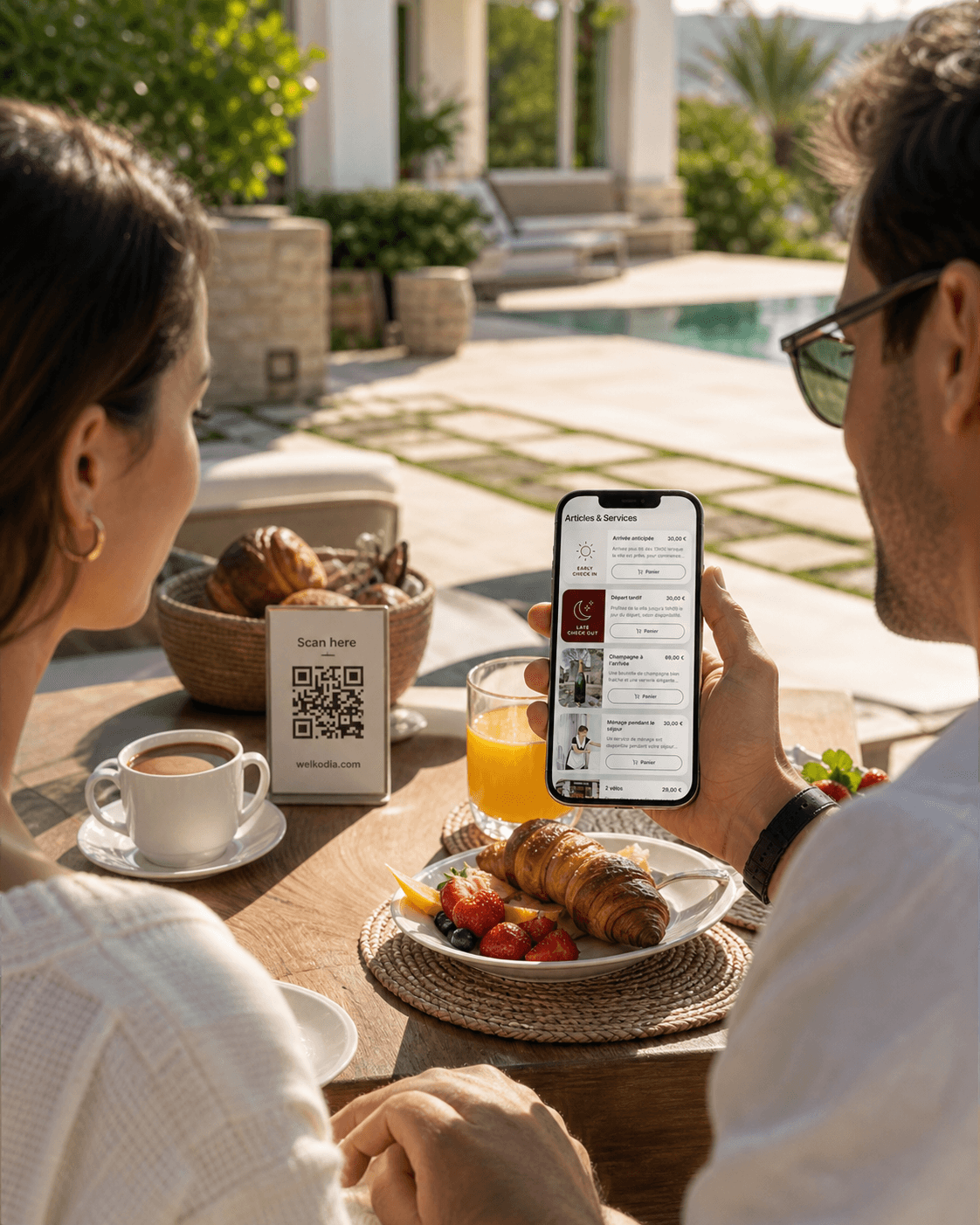
Turn usual guest requests into clear upsells
Present early check-in, late checkout, kits, transfers, and local services inside the guest journey.
Final takeaway
$200 per month from one property is usually not hiding in one impressive premium add-on.
It is usually hiding in the requests you already get, but still handle informally.
Start with 3 to 5 offers. Keep the menu tight. Make each service visible, clear, and easy to fulfill. Then track what guests actually buy.
Do not build a concierge business. Productize the requests you already get.
FAQ
Is $200 per month a guarantee?
No. The article presents it as a practical planning model, not a guaranteed outcome.
Where is that extra revenue usually hiding?
In repeated guest requests that are still being handled informally, such as late checkout, parking, transfers, welcome baskets, or other small conveniences.
What kinds of extras work best for one property?
The article recommends simple, repeatable offers like late checkout, early check-in, private yoga sessions, parking, luggage help, cleaning, transfers, or a welcome basket.
Why do many upsells fail before guests buy?
Because visibility and timing fail first. The offer is hidden in messages, shown too early or too late, described vaguely, or missing a fulfillment rule.
How many offers should a host launch first?
Usually 3 to 5. The goal is a small, clear menu rather than a long list that creates hesitation.
What is the difference between manual negotiation and a productized offer?
A manual negotiation rebuilds the same conversation every time. A productized offer keeps the price, conditions, and request flow clear even if approval still depends on availability.