
Create your digital guidebook with upsell store
Create my guidebook ->A guest asks if they can drop bags before check-in. Another wants to stay until noon on departure day. A guest asks for an extra mid-stay clean. Those are not just support questions. They are buying signals.
The wrong instinct is to chase ever more creative upsells. The better move is to structure what guests are already trying to buy informally.
Here is the cleanest playbook to start with: 12 simple services that are easy to understand and already connected to real stay friction.
Quick Answer: The most profitable upsells solve immediate guest problems. Instead of offering complex luxury packages, sell early check-ins, late checkouts, luggage storage, and firewood. Place these offers in your digital guidebook so guests can buy them exactly when the need arises.
| Service | Best moment | Why it sells |
|---|---|---|
| Early check-in | after booking | removes waiting |
| Late checkout | the day before departure | buys back time |
| Luggage drop-off or storage | before check-in or after checkout | simplifies logistics |
| Reserved parking | before arrival | reduces uncertainty |
| Airport or station transfer | before arrival | removes a tiring decision |
| Grocery pre-stock | first evening | avoids a shopping trip |
| Breakfast basket | first morning | removes an errand |
| Mid-stay clean | after booking | keeps the space fresh for longer stays |
| Extra linens or towels | during the stay | adds immediate comfort |
| Mid-stay cleaning | longer stays | removes a chore |
| Romantic or birthday setup | before arrival | strengthens the reason for the stay |
| Bike rental | while planning the stay | fits the local use case |
Quick filter
If guests already ask for it, can understand the benefit in one sentence, and you can deliver it without messy back-and-forth, it is strong enough to test.
The best upsell ideas are usually already hiding in your guest messages
Many hosts look for upsell ideas as if they need to invent a new menu.
In practice, the raw material is usually already there: early arrivals, parking questions, breakfast, transfers, grocery pre-stock, local activities.
When the same request keeps coming back, you are not just seeing repetition. You are seeing demand that has not been structured yet.
The same audit that helps reduce repetitive guest messages also helps you find the right services to sell. It is the same logic behind the host messages you should stop repeating: recurring questions usually deserve a better system.
To turn a repeated request into a real paid service, use this simple filter:
- 1.It shows up across multiple stays.
- 2.The benefit is obvious in one sentence.
- 3.Delivery stays reliable, even on busy days.
- 4.The service genuinely uses time, inventory, availability, or coordination.
A good upsell is not only useful. It is also clean to explain and clean to fulfill.
The real STR upsell playbook: sell time, comfort, or expected logistics
The 12 services above work for a simple reason: they plug into a moment the guest already understands.
Early check-in, late checkout, and luggage storage sell time. The guest is not really paying for a line item. They are paying for a less fragmented arrival or a less rushed departure.
Reserved parking, transfer, and grocery pre-stock sell logistics the guest already expects to solve somehow. These are decisions they would otherwise need to make alone, often when they are tired.
Breakfast baskets, grocery pre-stock, and mid-stay cleaning sell concrete comfort. They ask for almost no imagination, which is often why they convert better than more abstract extras.
Romantic setups and bike rentals are a little different. They do not fit every property. They work when they extend an intention that is already part of the trip: celebrating something, enjoying the destination, or saving time on an activity the guest was already planning.
The best add-on services rarely look like a catalogue. They look like friction removed at the right moment.
Do not charge for basic reassurance
An upsell system gets fragile the moment everything starts to feel monetized.
The Wi-Fi code, arrival instructions, lock guidance, useful contacts, or the minimum guest supplies are not upsells. They are foundations.
Charging for the basics does not feel premium. It feels withholding.
| Charge for it when... | Keep it free when... |
|---|---|
| the service uses time, inventory, or limited availability | the information is required to use the property |
| the benefit is optional but clear | it is basic reassurance |
| the operation has a real cost or constraint | the absence of it would create immediate frustration |
| the guest can easily say yes or no | you are actually compensating for a process problem |
That distinction matters because it protects both trust and margin.
When the essentials already live inside a digital guest guidebook or a guest QR code flow, the paid options become easier to understand. Free builds confidence. Paid stays optional.
Placement often matters more than price
Many useful services sell badly not because the price is wrong, but because the offer appears in the wrong place.
An upsell buried in a long Airbnb thread is easy to miss. An offer pushed too early feels commercial. A service shown right before the relevant moment usually feels far more natural.
Where to place the 12 services
- 1Right after booking: early check-in, transfer, breakfast basket, parking.
- 2Between 24 and 48 hours before arrival: grocery pre-stock, breakfast basket, luggage drop-off.
- 3In the property or inside the guidebook during the stay: cleaning, bikes, local activities, and other contextual extras.
If your bigger goal is to increase revenue per booking without making the experience heavier, this is the same mechanism behind increasing revenue per booking without raising your nightly rate: a small, well-timed offer usually beats a big menu shown at the wrong moment.
Your arrival is coming up.
If you would like early check-in, reserved parking, or a breakfast basket for your first morning, everything is available here: [link].
We keep the selection short so you only see the options that are actually useful before arrival.
Where Welkodia fits
A strong upsell system is not a longer message thread. It is a clearer structure.
In practice, that means one stable place for essential information, one clean place for paid options, and one simple access point guests can reopen at the right moment.
That is exactly where a digital guest guidebook paired with a services store helps. The guidebook gives the context. The store gives the action. And the guest QR code reduces the need to resend the same explanations manually.
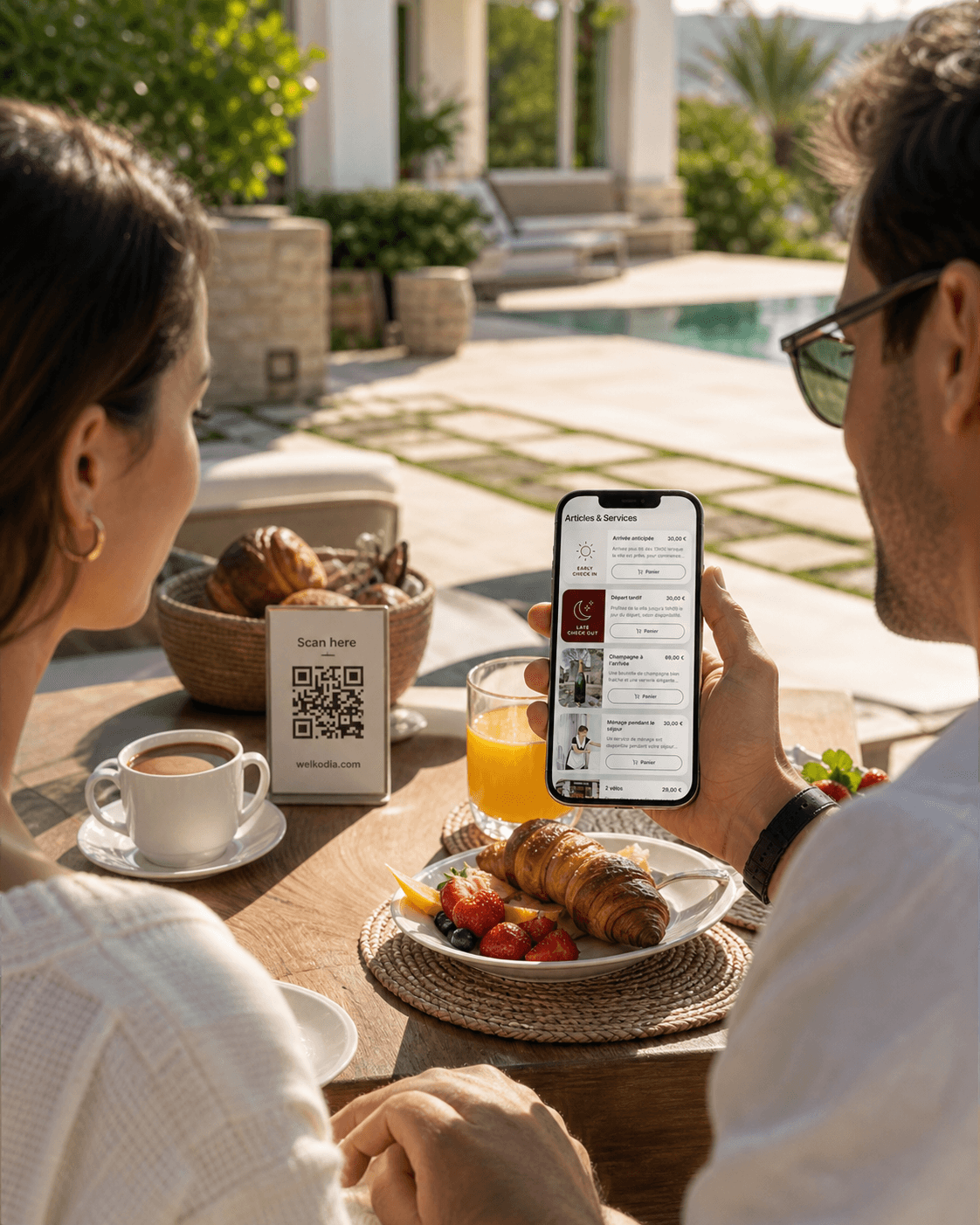
Turn usual guest requests into clear upsells
Present early check-in, late checkout, kits, transfers, and local services inside the guest journey.
Final takeaway
The best STR upsell is rarely the most impressive one.
It is usually the service the guest was already trying to buy, but previously had to negotiate by message.
Start small. Keep 2 to 4 visible options per property. Remove what creates friction. Reinforce what removes real friction.
When a service saves time, simplifies arrival, or makes the stay smoother, it feels less like selling and more like good hospitality.
FAQ
Where do the best upsell ideas usually come from?
From repeated guest requests already showing up in messages, such as early arrival, parking, breakfast, luggage, or grocery needs.
What do these 12 services really sell?
They sell time, comfort, or expected logistics around the stay rather than abstract premium ideas.
Why should hosts avoid charging for basics?
Because Wi-Fi, access instructions, useful contacts, and minimum guest supplies are foundations, not premium upsells.
Does placement matter more than price sometimes?
Yes. The article argues that many services underperform because they appear in the wrong place or at the wrong moment.
How many visible options should a host start with?
The final guidance is to start small, with only 2 to 4 visible options per property.
What role does the guidebook play in this playbook?
It gives essential information one stable home, while the services store and QR access make paid options easier to reopen and request.