

Create your digital guidebook with upsell store
Create my guidebook ->If you run a short-term rental or a concierge agency, you know the fatigue of receiving a message at 10:30 p.m.: "Hi, is it possible to leave our bags somewhere tomorrow?" or "Can we checkout at 1:00 p.m. instead of 10:00 a.m.?"
You are in bed, trying to disconnect after a long day of guest coordination. Now you have to open your calendar, check if the next guest is arriving tomorrow, message your cleaner to see if their morning schedule is flexible, wait for their reply, and then message the guest back.
If you say yes for free, you just gave away high-margin operational time. If you try to charge by improvising a price, you feel like a merchant haggling over details. Most hosts do not need more creative upselling ideas; they need a system to turn these recurring guest frictions into structured, visible, and automated choices.
Quick Answer: Avoid sending text messages to pitch upsells to your guests. Instead, place your offers inside the digital guidebook they are already using to find the Wi-Fi. Let them view the price, click a button, and pay with their credit card automatically.
Quick rule
An extra is only ready when the guest benefit is obvious in one sentence, the price is set, and the execution is boringly simple.
Why most Airbnb upselling fails before the guest says no
When hosts tell me "upsells just do not work in my area," they are almost always looking at the wrong culprit. They think guests are cheap, or that they need to offer helicopter tours to get anyone's attention.
But here is what actually happens: they mention early check-in once in a massive, 8-page welcome email sent three days before arrival. The guest is packing, dealing with airports, or trying to remember where they parked their car. They do not read it. Then, during the stay, they ask for things by message, which triggers a painful round of negotiations. By the third back-and-forth, everyone is exhausted, and the host just gives it away for free to avoid a bad review.
A service is not working if it requires a conversation to buy it.
An extra that is technically "available" but hard for a guest to find is practically non-existent.
Conversely, an extra that is visible but vague creates a new operational headache: it sells more work instead of selling a clear convenience.
If you are looking for a list of service ideas, our article on 50 guest extras you can sell without annoying guests already covers that groundwork. Here, we focus on the mechanics: how to make a handful of practical extras actually buyable without creating more inbox chaos.
The 4 pillars of a reliable guest extra
I like to tell my friends that a service is not ready to launch until it passes a basic stress test.
First, can the guest find it at 9:00 p.m. without scrolling through ten text messages? Second, is it priced so clearly that there is no room for negotiation? Third, do you have a dead-simple rule for when it is allowed (like blocking late checkout if another guest is checking in the same day)? And finally, does your cleaner know what to do, or are they going to walk in on the guest in the shower?
If you do not have answers to these, you do not have an offer; you have a recipe for stress.
Without an eligibility rule, a late checkout offer becomes an ongoing negotiation.
Without a booking cutoff, an airport transfer becomes a last-minute emergency.
Without pre-defined packages, a stocked-fridge service turns into a custom grocery run.
A service without a structured fulfillment rule is not an offer; it is a fragile promise.
Case study: Turning manual late checkout loops into structured offers
Let us look at late checkout, because it is the classic example. We have all been there: a guest texts you at 9:00 p.m. the night before they leave, asking for a few extra hours.
You want to be nice, but your cleaner has a tight schedule. So the loop begins. You text the cleaner. You wait. You check if the next booking is arriving. The cleaner replies at 7:00 a.m. saying they can start later but need some extra pay. You text the guest: "Sure, we can do 1 p.m. for $30." The guest reads it, does not reply, leaves at 11:30 anyway, and you never collect the money.
Now, compare that to a friend of mine who set up a simple rule. His guests get a link to their digital guidebook. If there is a guest arriving the next day, the "Late Checkout" button simply is not there. If the day is free, the button is active: $35, pay via Stripe, cutoff at 6:00 p.m. the night before.
No messages, no morning panic, no chasing money. Just a guest getting a relaxed morning and the host getting a clean $35 that goes straight to their bank account.
This structure is what protects your time and profit margin on minor transactions. If your primary goal is maximizing revenue per stay, the same principles apply. As discussed in our guide on how to add $200/month in guest upsells from one property, the real victory is preventing recurring requests from turning into repetitive manual chores.
Start with practical services instead of complex experiences
One of the biggest traps is trying to be too fancy. I see hosts spending weeks calling local vineyards for wine tours, organizing complex excursions, or partnering with private chefs. It feels exciting, but it almost always ends in zero sales and a lot of wasted energy.
When someone checks into your place after a long, exhausting travel day, they are not looking for a curated lifestyle. They are looking for convenience. They want a cold bottle of water, a place to leave their heavy bags, or a guaranteed parking spot so they do not have to circle the block five times.
Start with the basics: early check-in, late checkout, or a simple welcome basket with local snacks. These are services you can fulfill in ten minutes, and they solve real, immediate pain.
- late checkout
- early check-in
- reserved parking
- luggage storage
- mid-stay cleaning
- airport or station transfer
- stocked fridge with 2 or 3 fixed packs
- a simple celebration setup that is easy to deliver cleanly
These practical services have one decisive advantage: the guest understands the value instantly without needing a sales pitch.
They are also highly repeatable across multiple listings. For property managers, this standardization is essential for scaling operations without relying on one-off favors.
Ambitious experiences like private chefs or local tours can always be added later. But launching them before you have structured the basics is simply stacking complex coordination onto a fragile foundation.
Avoid choice overload: Keep your services menu simple
Think of it like a restaurant menu. If you walk into a diner and they have ten pages of options, you freeze. If you walk into a nice bistro and they have three specials, you order in two minutes.
It is the same for your guests. If your guidebook has twenty different upsells, it starts looking like a cheap commercial flyer rather than a welcoming home. Keep it down to three or four solid options. Not only does it make it easier for the guest to choose, but it also saves your sanity. Fulfilling one or two clean services perfectly is a hundred times better than managing a messy catalog that nobody buys anyway.
Why pre-arrival messages are not enough for upselling
Mentioning your extras once in a pre-arrival email is better than nothing, but it has major limitations. When your message arrives, the guest might be boarding a flight, driving, or simply not ready to think about check-out times yet.
By the time the need arises days later, they are unlikely to scroll back through a long Airbnb thread to find that single mention.
Your offers do not need to be louder or more frequent; they need a stable, accessible home.
This is where a digital guidebook paired with an upsell store becomes essential. The guidebook provides the context; the store drives the action.
If you only mention your services in the booking confirmation message, you are missing the window. When a guest first books, they are excited about the trip, not thinking about check-out times. Three days later, they are worrying about flights. During the stay, they are looking for local spots. You want to present the right option when the friction actually hurts.
Here is how that timing looks in practice:
Show the right extra at the right stay moment
- 1Right after booking: This is when they worry about arrival logistics. Offer them early check-in or a guaranteed parking spot so they can plan their travel day.
- 2A day before arrival: They are packing and realizing they will arrive late. Offer a stocked fridge with breakfast essentials so they do not have to find a grocery store at midnight.
- 3During the stay: They are settled in and enjoying the trip. Offer a mid-stay clean or fresh towels if they are staying longer than a few days.
- 4The day before departure: They are dreading the packing and departure rush. This is the absolute golden hour to offer late checkout or luggage storage.
To drive conversions during the stay, placing a physical guest QR code inside the property allows guests to access these offers exactly when the need hits them. It does not change the underlying logic of your offer; it simply brings it within arm's reach.
How to sell guest services without being pushy
I hear a lot of hosts worry about sounding like "salespeople." They write apologetic, vague sentences like: "Let us know if you need anything else, we might be able to help."
That is actually more annoying for the guest because it requires them to ask for the price, negotiate the time, and guess what you can actually do.
Selling without being pushy is about clarity and pride. If you are offering a late checkout that lets a family sleep in and coordinate their flight, you are providing a genuine service. Be proud of it. State the price clearly. Make it completely optional, make the terms obvious, and only show it when it is useful.
- Backed by genuine value: If you are providing real value and you are proud of the service you want to give, propose it; if not, don't.
- Entirely optional: The guest must never feel forced or pressured to buy.
- Transparently clear: The price, the benefit, and the fulfillment rules must be obvious from the start.
- Visible only when relevant: Shown only when and where the guest is most likely to need it.
A direct line like "Late checkout until 1 p.m. is available for $30" is not pushy. It is helpful. It gives the guest complete control over their morning without making them feel pressured.
Guests do not feel pressured when they instantly understand the price, the benefit, and how to buy it. In practice, upsells only become annoying when they mimic hidden fees or require forced conversations.
Check compliance rules and operational deadlines before selling
If a booking originates on Airbnb, you cannot assume you can collect payments however you want. The platform has strict guidelines on how fees are disclosed and processed. Always consult the official Airbnb Help Center guidance before implementing your payment flows.
But compliance is only one side of the coin. The other is fulfillment.
A service is a massive liability if you do not have a solid rule to back it up. Ask yourself:
- Who is responsible for delivering the service: If the guest orders a late check-out, does the cleaner know? Or will they show up at 10:00 a.m. anyway, enter the property while the guest is in the shower, and create an awkward situation that ends in a 1-star review?
- The booking deadline (cutoff time): If a guest wants a bottle of champagne at 11:00 p.m., do you have to drive to the property yourself? Or is there a 24-hour cutoff that blocks last-minute orders?
- Exactly what is included and excluded: Does 'stocked fridge' mean a full grocery list or a fixed continental breakfast pack?
- A fallback plan if the service is no longer available: How do you refund a guest if your cleaning partner cancels the mid-stay clean?
If your main hurdle is operational execution rather than sales, our guide on how to sell Airbnb extras without managing every service yourself is the logical next step.
The operational benefits of upselling for property managers
If you are managing properties for other owners, this is not just about making a few extra dollars on a late checkout. It is about professionalizing your business.
Every manual request you eliminate is a message your team does not have to answer on a Saturday night. It means your cleaners have a clear schedule on their dashboard, rather than getting frantic texts about delays. And when you sit down with your property owners for your monthly review, showing them a report with an extra $300 or $500 in clean service revenue is a massive differentiator. It proves you are not just holding keys; you are maximizing their asset.
How Welkodia simplifies guest upselling
This is why we built Welkodia. We wanted to take the friction out of these daily operations.
Instead of sending long PDFs or managing endless chat threads, you give your guests a simple, beautiful digital guidebook. They get all the house info they need, and when they want an extra, the upsell store handles it. If a late checkout is booked, the system processes the payment via Stripe, updates the schedule, and if you are using Welkodia Pro, it routes the alert directly to your cleaner.
You do not have to do a thing. The system protects your time, keeps your team aligned, and takes care of the guest.
If you are still weighing your options, our comparison of a digital guidebook vs guest app vs PDF details why your delivery format dictates your upsell success.
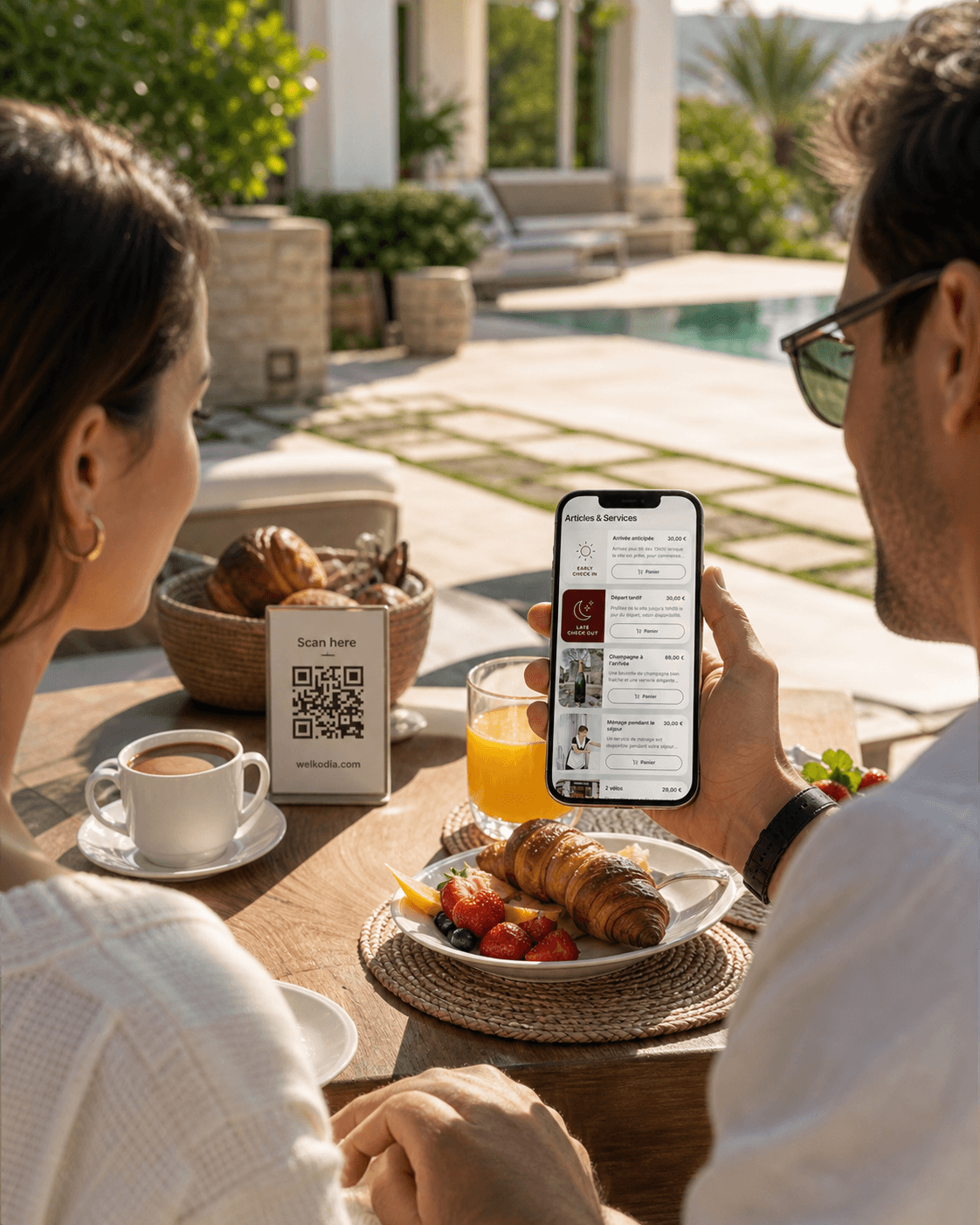
Turn usual guest requests into clear upsells
Present early check-in, late checkout, kits, transfers, and local services inside the guest journey.
Key takeaway
At the end of the day, guests are happy to pay for services that make their lives easier. Upselling fails when the offer is invisible, vague, or creates a chore for the guest.
Pick two or three practical services. Set a fair price, write down your cutoff rules, and make sure your team is on board.
The goal is not to be a pushy salesperson. The goal is to make buying so simple that the guest gets a better stay, and you get your evenings back.
Mental model: A great upsell is just a friction point you solved in advance, presented at the exact moment it hurts, with an execution rule so clear that you never have to think about it twice.
FAQ
Why do Airbnb upsells often fail even when guests ask for extras?
They usually fail because the offer stays buried in messages, the price is unclear, or the fulfillment rule is still manual.
What are the best first extras to structure?
The article recommends practical services first: late checkout, early check-in, parking, luggage help, mid-stay cleaning, transfers, fixed fridge packs, or a simple celebration setup.
Are pre-arrival messages enough to sell extras well?
No. The article argues that messages are too easy to miss once the real need appears later in the stay.
How many services should a host show at first?
Keep the menu tight. Three or four solid options are usually easier to trust and fulfill than a large catalog.
How do you make an upsell feel helpful instead of pushy?
State the value clearly, keep it optional, make the price obvious, and only show it when it is actually relevant to the guest.
When should hosts think about compliance before selling extras?
Before standardizing the flow. The article explicitly says to check Airbnb's current fee and payment guidance before implementing collection methods.