

Create your digital guidebook with upsell store
Create my guidebook ->A guest arrives at 11 p.m., stands outside with bags, and cannot find the lockbox photo. You already sent it. It is just buried in the Airbnb thread.
That is the real question behind a guest app.
It is usually not "Do guests want another app?" It is "Does this property need one stable place where guests can reopen the right answer without asking again?"
For many Airbnbs, the answer is still no. Airbnb already gives hosts useful built-in tools such as a house manual, guidebooks, check-in details, and scheduled quick replies for booking, check-in, and checkout moments.
But those tools do not solve every operating problem. Messages are time-based. Guest problems are situation-based.
If your guests keep asking where to park, how to enter, how to use the hot tub, what to do with trash, whether late checkout is possible, or where to find a decent late-night restaurant, a guest app can start to make sense.
Quick Answer: Do not force guests to download an app from the App Store just for a three-day stay. A simple web link to a digital guidebook works much better because guests can click it from a text message and immediately see the door code, Wi-Fi password, and house rules.
The short answer
| Situation | Deploy a guest app? | Why |
|---|---|---|
| One simple property, few repeated questions, no add-ons | Probably not yet | Airbnb tools may already cover the need |
| Repeated questions about access, Wi-Fi, parking, heating, trash, or checkout | Yes, probably | The problem is now structural, not occasional |
| Complex property with equipment, shared building rules, pool, hot tub, or tricky arrival | Yes | Guests need one stable operating layer |
| You want to offer extras like late checkout, mid-stay clean, or transfer | Yes, if the workflow is clear | Visibility and rules matter as much as the offer |
| You only want something that "looks more premium" | No | A brochure does not reduce friction by itself |
The practical rule is simple: deploy a guest app when the property creates enough repeated friction to justify one permanent, reopenable guest system.
The hidden problem is information decay
Hosts often think they have an information problem. Usually they have a retrieval problem.
The Wi-Fi code was sent. The parking note was sent. The check-in steps were sent. The checkout reminder was sent.
Then time passes.
The guest lands, scrolls through six travel apps, opens WhatsApp, loses signal in the elevator, and no longer remembers where the parking photo was. The information existed. Its usefulness decayed.
That is why the line worth remembering is this:
The answer does not need to be sent again. It needs a stable place to live.
Airbnb's communication tools are still useful here. Scheduled quick replies are strong for timing, reminders, and repetitive message triggers around booking, check-in, and checkout. The house manual is useful for confirmed guests who need property information in one place. But those tools do not fully replace a host-controlled stay layer when the property has real operational complexity.
If you want the format comparison behind that idea, the companion article on digital guidebook vs guest app vs PDF goes deeper into which format is usually the better default.
A guest app works only when it becomes a stay operating system
This is where many hosts get it wrong.
A weak guest app is just a digital brochure: welcome text, a few pretty photos, maybe a recommendation list, and a QR code no one scans.
A useful guest app behaves more like a stay operating system:
- one place for arrival instructions
- one place for Wi-Fi and house basics
- one place for equipment guidance
- one place for local recommendations guests can reopen later
- one place for clear optional requests such as late checkout or grocery delivery
- one place for departure steps
That is the difference between something that looks modern and something that actually reduces work.
If you are still repeating many of the same answers manually, start with 15 Airbnb host messages you should stop repeating manually. It is often the fastest way to see whether your property has enough friction to justify a better guest system.
When a guest app is worth deploying
The best trigger is not portfolio size. It is repeated operational drag.
One complicated Airbnb can justify a guest app faster than five easy ones.
It becomes worth deploying when at least one of these is true:
1. Arrival keeps creating support load
Guests ask where to park, how to find the door, which code to use, which entrance matters, or what to do if the lockbox fails.
This is one of the strongest use cases because arrival friction hurts the stay immediately. It also creates the most urgent messages.
2. The property has equipment or rule complexity
Hot tubs, pools, shutters, heating systems, coffee machines, trash sorting rules, shared-building rules, and noisy-neighbor constraints all create questions that are easy to standardize.
If the answer should exist near the moment of need, a guest QR code setup becomes more useful than another paragraph in a pre-arrival message.
3. You keep negotiating the same extras manually
Late checkout, early check-in, grocery pre-stock, luggage storage, transfer, extra cleaning, or firewood are not just "nice to have" items.
They are repeat workflows.
If late checkout is handled only by message, every request becomes a negotiation. A guest app can turn that into a visible rule with timing, conditions, and next steps.
4. You manage several properties or need owner-facing professionalism
For co-hosts, property manager teams, and STR managers, the guest app is not only for travelers. It is also proof of system quality.
Owners do not just want to hear that things are organized. They want to see that every property has a clear guest flow, reusable information structure, and less dependence on staff memory.
5. Guests need one place they can reopen during the stay
This is the biggest one.
If guests often need the same information at different times, the property is a good candidate for a no-download, mobile-friendly digital guest guidebook, whether you call it a guest app or not.
When you should probably not deploy one yet
There are also cases where a guest app is unnecessary overhead.
Do not rush into one if:
- the property is operationally simple
- you get very few repeated guest questions
- there are no realistic extras to structure
- you are mainly chasing a more "premium" look
- you are not ready to keep one source of truth updated
Good decision rule
If the app would create more maintenance than message reduction, it is too early.
For a single simple Airbnb, the first win may be a cleaner message system, a better house manual, and a clearer arrival guide. The app only becomes valuable when it removes repeated work or captures useful revenue.
What should the first version actually include?
Not everything.
Build the first version around the moments where guests actually get stuck.
Start with these sections first
- arrival and access
- parking
- Wi-Fi
- heating and AC
- trash and house rules
- key appliances
- local essentials such as pharmacy, supermarket, and transport
- checkout checklist
Then add extras only if you can fulfill them reliably.
That means defining:
- 1.availability
- 2.request deadline
- 3.price
- 4.who delivers it
- 5.cancellation rule
- 6.confirmation flow
The article on what to put in a digital guest guidebook so it is actually useful is the practical next read if you want the exact content logic.
The best guest app is usually not a downloadable app
For most short-term rentals, the phrase "guest app" is slightly misleading.
What usually works best is not asking travelers to install software. It is giving them a mobile-friendly link they can reopen easily, plus a QR code inside the property where the need appears.
That matters because short stays leave very little tolerance for setup friction. Guests are not trying to adopt your tool. They are trying to solve a small problem quickly.
The stronger pattern is usually:
- 1.send the link at the right time through Airbnb messages
- 2.keep the first screen practical, not brand-heavy
- 3.place QR codes where the question happens
- 4.redirect repeated questions into permanent sections over time
If you want the QR side of that workflow, how to use QR codes in an Airbnb to drive real guest actions is the best companion piece.
A guest app can also grow revenue per stay
This is the second reason the right guest app matters.
Once the information layer is clear, the app can stop being just a support tool and start becoming a revenue layer too.
The wrong way to think about upsells is "What can I try to sell?"
The better question is: Which guest requests already happen often enough that they should become visible, structured options instead of manual conversations?
That is how a guest app helps you increase revenue per stay without making the experience feel heavier. You are not inventing random products. You are monetizing useful moments around the stay.
| Service to offer | Example USD range | What the guest is really buying | Why it sells |
|---|---|---|---|
| Early check-in | $20-$60 | less waiting after travel | removes arrival friction |
| Late checkout | $25-$75 | a calmer departure morning | buys back time |
| Reserved parking | $10-$40 | less uncertainty on arrival | solves a real logistics problem |
| Airport or station transfer | $35-$120 | an easier last-mile trip | reduces fatigue and decision-making |
| Grocery pre-stock | $30-$120 | no first-night shopping run | adds immediate comfort |
| Breakfast basket | $15-$45 | an easier first morning | removes a small errand |
| Firewood bundle | $15-$30 | one less trip to the store | adds comfort |
| Mid-stay cleaning | $60-$180 | less effort during longer stays | sells convenience |
The pattern is consistent: the best extras usually sell time, comfort, or logistics.
These are example pricing bands, not fixed rules. The right range depends on your market, property type, local costs, and how operationally easy the service is to fulfill.
If a guest app only stores information, it can reduce messages. If it also surfaces the right optional services at the right moment, it can increase revenue per booking as well.
Simple upsell rule
Start with 2 to 4 extras per property.
- pick the requests guests already make
- keep the benefit obvious in one sentence
- only show services you can deliver reliably
That is also why visibility matters so much. A service that exists but is buried in a message thread barely exists commercially. A service shown at the right moment inside the guest flow has a real chance to convert.
If you want the deeper playbook, read The STR Upsell Playbook: 12 Services Guests Already Want to Buy and how to increase revenue per booking without raising your nightly rate.
Where Welkodia fits naturally
Once the problem is clear, the product angle becomes straightforward.
Welkodia is useful when you want one stable guest layer that combines:
- a digital guest guidebook for property information
- a guest QR code for moment-of-need access inside the property
- a services store for structured extras instead of manual negotiations
That matters most when the goal is not "better hospitality" as a vague promise, but fewer repeated messages, clearer arrival and checkout flows, better visibility for useful extras, stronger revenue per stay, and a more professional operating system across one or several properties.
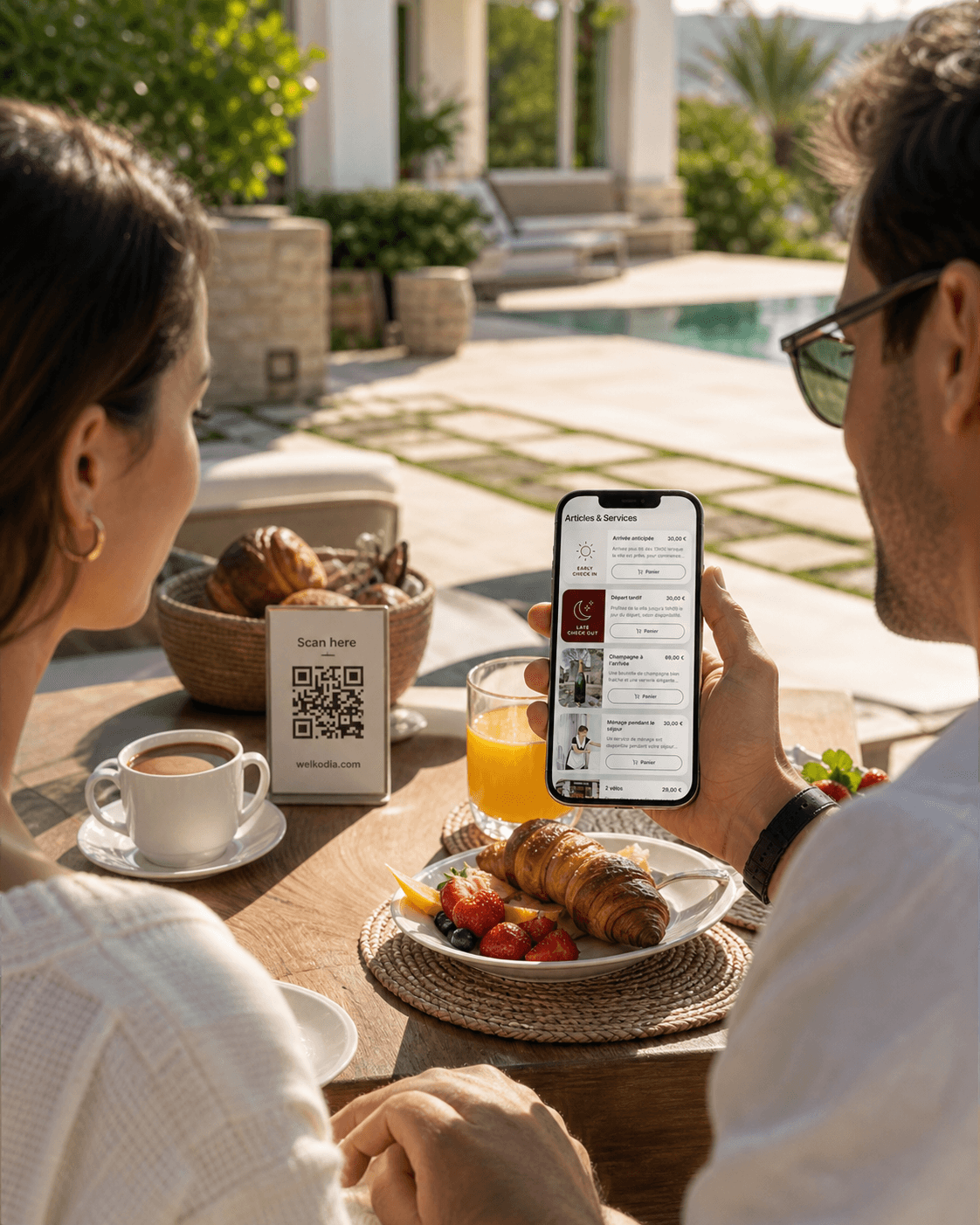
Turn usual guest requests into clear upsells
Present early check-in, late checkout, kits, transfers, and local services inside the guest journey.
Final takeaway
Not every Airbnb needs a guest app.
But many hosts are asking the wrong question.
The real test is not whether guests want another app. It is whether this property creates enough repeated friction that guests need one stable place to find answers, follow instructions, reopen recommendations, and request useful extras without turning everything into another message.
If the answer is yes, deploy one.
Just make sure it behaves like an operating system for the stay: one that reduces support load, makes the experience clearer, and helps you monetize useful stay moments without adding chaos.
FAQ
Does every Airbnb need a guest app?
No. The article says many simple properties can still rely on Airbnb's built-in tools if repeated friction stays low.
What is the clearest sign a guest app is worth it?
Repeated operational drag: access questions, equipment confusion, manual extras, or guests needing the same information at different moments.
What should the first version include?
Start with the places where guests get stuck most often: arrival, parking, Wi-Fi, heating or AC, trash, key appliances, local essentials, and checkout.
Should hosts build a downloadable app first?
Usually no. The article says the best guest app for most stays is often a no-download, mobile-friendly guidebook experience.
When should a host avoid deploying one yet?
When the property is simple, repeated questions are rare, there are no realistic extras to structure, or the app would create more maintenance than message reduction.
Can a guest app help revenue as well as support?
Yes. Once the information layer is clear, it can also surface useful extras like early check-in, late checkout, parking, transfers, or a grocery pre-stock.