

Create your digital guidebook with upsell store
Create my guidebook ->A guest staying 10 nights sends a message on Tuesday evening: "Can we get a mid-stay cleaning on Thursday morning?" Most hosts read that as extra work. The better move is to turn it into a paid Airbnb extra that is already assigned to the right provider before the guest even asks.
That is how hosts can sell extras and upsells without managing every service themselves: the service lives in the guidebook, the order is pre-routed to a cleaner, contractor, or local partner, and the host only steps in when something unusual happens.
The important shift is this: the host is not supposed to perform every extra. The host is supposed to build the system once.
Quick Answer: You can sell extras like mid-stay cleanings or grocery delivery without doing the work yourself. Set up a system where the guest's order sends an automated email or text directly to your cleaner or local provider. Define exactly who does the work and by when, so you don't get stuck acting as the middleman.
Most hosts do not have an upsell problem. They have a handoff problem.
If you look at how most Airbnb extras fail, the problem is rarely the idea.
Guests already want late checkout, airport transfers, early check-ins, extra linens, grocery pre-stocking, and Airbnb mid-stay cleaning. The market already understands these offers. The real failure happens one step later, when nobody has clearly been given the job.
That is why some hosts say upsells are "not worth it." What they often mean is: "Every extra I sell comes back to me as coordination."
When every sale requires manual coordination, your margins shrink. The host is forced to act as an intermediary, forwarding messages, chasing payments, and relaying access codes. At that point, you aren't selling a scalable service—you are selling your own coordination time.
| What the guest sees | What the host often ends up doing |
|---|---|
| "Mid-stay cleaning available" | checking provider availability |
| "Airport transfer available" | forwarding timing and pickup details |
| "Early check-in available" | confirming property readiness and cleaner departure |
| "Late checkout available" | manually approving each case and re-explaining the rule |
If you want broader upsell ideas first, The STR Upsell Playbook: 12 Services Guests Already Want to Buy and Airbnb Upsells: 50 Guest Extras You Can Sell That Guests Actually Ask For cover that side well.
This article is about the next layer: how to sell the extra without becoming the person who has to carry it across the finish line.
The difference between a nice offer and a real system
Consider the difference between a manual request and a structured system.
Scenario A: The Manual Coordination Loop
When a guest requests a mid-stay cleaning for Thursday, it triggers a cascade of manual steps:
- 1.The Host checks the cleaning calendar and texts the cleaner.
- 2.The Cleaner asks which property, the preferred time slot, and if fresh linens are needed.
- 3.The Host relays the cleaner's questions to the guest.
- 4.The Guest replies, then asks for the price.
- 5.The Host calculates the price, requests payment manually, and waits.
- 6.The Cleaner asks for the access code and instructions.
By the time the cleaning happens, the host has spent 20 minutes acting as a human router for a $79 service. The service was listed, but it wasn't operationalized.
Scenario B: The Automated Handoff
Now, compare that to a pre-routed system:
- 1.The Guest scans the QR code, opens the services store, and selects "Mid-Stay Cleaning ($79)".
- 2.The Guest sees what is included (surfaces, towels, trash) and excluded (bedding, laundry), chooses Thursday morning, and pays.
- 3.The Cleaner automatically receives an assignment email with the property address, requested time window, specific task checklist, and the entry code.
The host never has to forward a message, re-explain the scope of work, or check calendar availability. The order routes itself directly to the person executing it.
This is the key distinction. Selling the service is only half the battle. Routing the service to the right provider automatically is what makes your upsells scalable.
What changes when the service is assigned before the guest orders
Passive income isn't built during setup; it is unlocked by the automated workflow that follows.
The host still has to find the cleaner, contractor, or local provider beforehand. The host still has to define the service page correctly. The host still has to decide what is included, what is excluded, how much notice is required, and what should happen if the provider is unavailable.
This approach is a game-changer if you manage properties remotely, live out of town, or are far from the location. When you cannot physically be on-site to handle last-minute requests, delegating to a reliable local provider is the only way to build a hospitality business that runs on auto-pilot.
Once the initial configuration is complete, the operational day-to-day flow changes:
- Every order starts as a handoff, not a new conversation.
- The system handles dispatching, so the host never has to manually coordinate schedules.
- The provider receives a concrete work order with exact instructions, rather than a vague text message.
The real win
The host is not trying to become the cleaner, the driver, the tour guide, or the chef.
The host is building a small service network where each extra already has an owner before the guest clicks buy.
That is why this model is so attractive for property managers and hospitality teams. It increases revenue without forcing the operator to personally deliver each service sold.
What Welkodia changes in that flow
In Welkodia's services store, a service item can be configured with a default assignee and an assignment deadline. That means a mid-stay cleaning, transfer, or other paid extra can already be tied to the right person before the guest ever orders it.
When the guest orders through the guidebook, that assignment is copied into the order flow. The assigned person receives the provider assignment email. They are not waiting for the host to manually forward the request.
Inside the team workflow, the assigned person can accept or refuse the assigned item within the deadline. If they accept, they take ownership of execution. If they refuse or do not respond, the team can step in, reassign, or take over.
That is a very different promise from a generic "sell extras" tool.
The value is not just that the guest can see the service. The value is that the order already knows where it has to go.
What the host no longer has to do on every order
- 1Re-explain who should handle the request.
- 2Forward the same service details manually.
- 3Re-send access notes and timing to the provider.
- 4Chase the provider for a yes or no by text.
- 5Reconstruct the service workflow from scratch.
That is why the guidebook matters here. The digital guidebook is not just an information page. The services store is not just a menu. And the guest QR code is not just a shortcut.
Together, they turn guest demand into an order flow that can be routed to the right service provider without dragging the host into every step.
The host still has to set up the service properly once
None of this works if the service page is vague.
If the provider receives an order but still has to ask what the service includes, the host is back in the loop. If the notice period is unclear, the host is back in the loop. If there is no fallback when the provider is unavailable, the host is back in the loop.
That is why a service description must read like a standard operating procedure (SOP), not a generic marketing pitch.
For each extra, define:
- 1.the provider or contractor who owns it
- 2.the exact scope
- 3.the notice period
- 4.the available window
- 5.the access note
- 6.Price and the % you'd like to keep
- 7.the backup plan if the assignee cannot take it
If even one of those pieces is missing, the order will leak back into manual coordination.
That is also why the best starting services are operational rather than purely recreational. Operational services like mid-stay cleanings, linen refreshes, airport transfers, and early check-ins work best because they have a predefined owner, a clear scope of work, and immediate utility for the guest.
10 services you can delegate today
If you want to offer more than the basics, you can partner with local professionals to delegate higher-end extras completely (for more ideas, see our list of 50 Airbnb upsell ideas). Here are 10 services you can list in your guidebook and delegate to third-party providers:
- 1.Private Chef & In-Villa Dining: Connect guests with a local chef who handles grocery shopping, custom meal prep, service, and kitchen cleanup.
- 2.Yoga & Fitness Instructors: Partner with certified instructors to guide guests through private yoga, pilates, or personal training sessions in the garden or living area.
- 3.Mid-Stay Cleaning & Sheet Refresh: Delegate to your current cleaning company, giving guests the option of a professional refresh for longer stays.
- 4.Dinner Catering & Delivery: Offer gourmet platters, breakfasts, or hot local specialties prepared and delivered by local catering partners.
- 5.Boat Charters & Excursions: Work with local captains or rental agencies to offer guests direct booking options for private cruises, watersports, or sunset tours.
- 6.Airport Transfers & Chauffeurs: Coordinate with a trusted taxi, shuttle, or premium private driver service to manage guest arrivals and departures.
- 7.Mobile Beauty, Nails & In-Room Spa: Partner with certified mobile nail technicians and beauty specialists that you can find through Naildexo or massage therapists who bring professional equipment directly to the property for an exclusive guest pampering experience.
- 8.Bike, E-Bike & Scooter Rental: Set up a referral program with a local shop that delivers rental bikes directly to the guest at the villa or apartment.
- 9.Grocery Pre-Stocking & Welcome Packs: Outsource shopping and fridge stocking to a local assistant or grocery delivery service before check-in.
- 10.Luggage Storage & Early Drop-off: Partner with a local shop or service to store guest luggage before check-in or after check-out, keeping your property clear.
By contrast, vague "property manager assistance" offers often fail because no one knows where the boundary starts or ends.
The host should own the system, not every task.
That is the real promise of this article.
The goal is to generate passive income: once the guidebook is live, the service is visible, the assignee is already attached, and the provider can carry the order from request to delivery without the host rebuilding the process each time.
If the host still has to manually relay every service order, then the host has not really delegated the work. They have only moved the payment step online.
If the contractor receives the assignment directly, understands the scope, and can act from there, the host has finally built something repeatable.
That is why the money is not really in "having more extras." The money is in having extras that are fulfillable without operational chaos. And if you also want to streamline emergency repairs and ongoing property upkeep, read our guide on how to find people to maintain Airbnbs.
If you want the guest-facing visibility layer behind that model, How to Use QR Codes in an Airbnb to Drive Real Guest Actions is the natural companion. If you want the broader revenue framing, How to Add $200/Month in Guest Upsells From One Property is the next step.
Turn your guidebook into a service store where guests order once, the right provider gets the task, and the host only handles the exceptions.
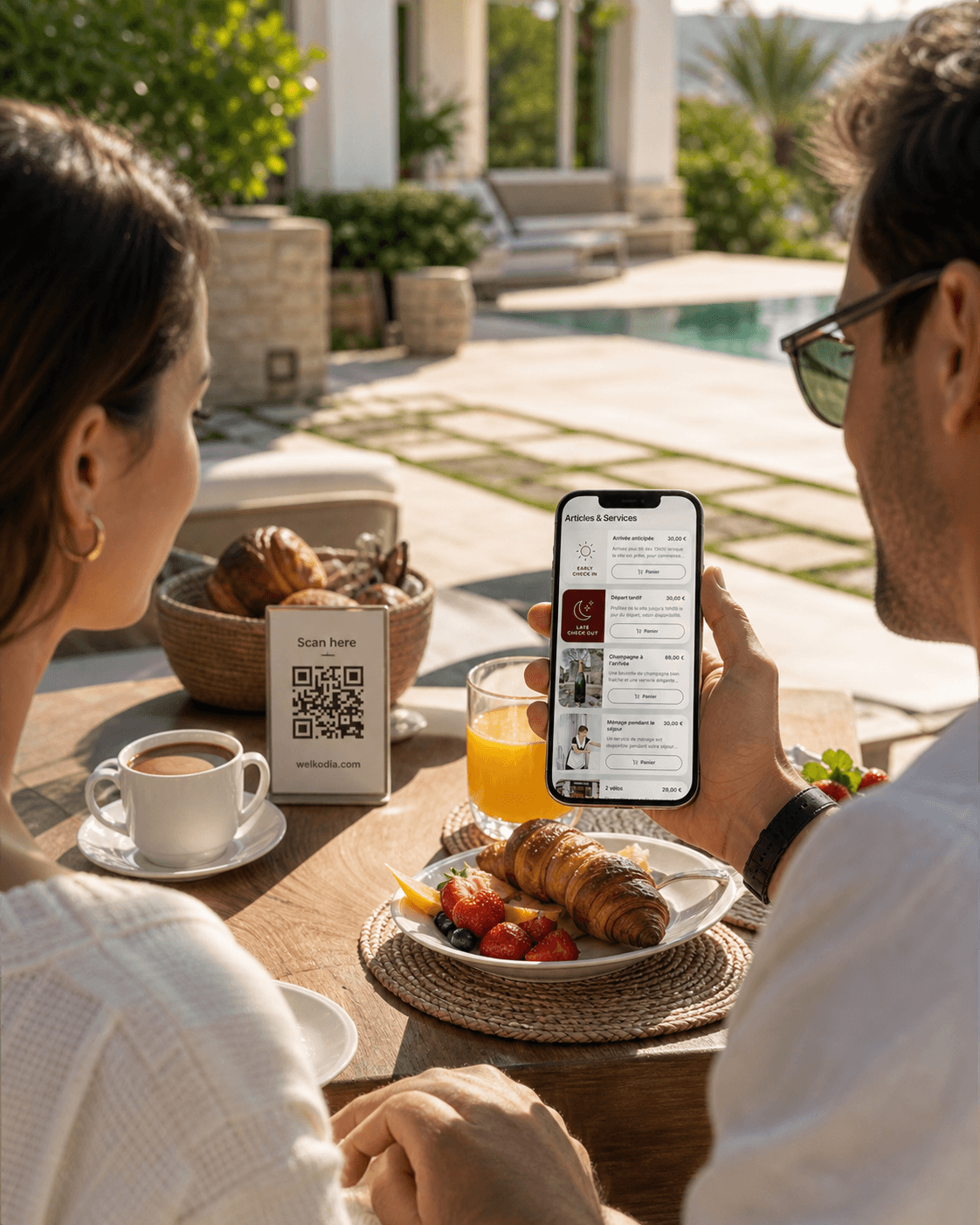
Turn usual guest requests into clear upsells
Present early check-in, late checkout, kits, transfers, and local services inside the guest journey.
Final takeaway
A successful upsell program isn't about selling more extras—it's about removing the friction of delivering them.
The primary reason hosts abandon upsells isn't a lack of interest from guests. It is the exhaustion of coordinating details manually. When every $50 or $79 order requires multiple text messages, coordination errors, and manual bank transfers, the margin is eaten by your time.
By shifting from manual routing to automated assignments, you turn guest services into a scalable asset:
- The Guest gets self-serve convenience and instant checkout.
- The Provider gets crystal-clear task parameters and instant notifications.
- The Host gets a new revenue stream without adding a single chore to their daily schedule.
Mental model -> The guidebook is the storefront. The provider is the fulfillment layer. Welkodia lets you assign the order to a service provider you choose. The host can finally stop doing the delivery work and let the provider execute and complete the order automatically.
FAQ
What is the main problem this article is trying to solve?
Not lack of guest demand, but the handoff problem that turns every sold extra back into manual host coordination.
What changes when a service is assigned before the guest orders?
Every order starts as a handoff, the system can dispatch it automatically, and the provider receives a concrete work order instead of a vague forwarded message.
What kinds of services work best first?
Operational services with a clear owner and scope, such as mid-stay cleanings, linen refreshes, transfers, and early check-ins.
What still has to be set up properly by the host?
The provider, scope, notice period, available window, access notes, pricing, and fallback plan all need to be defined once in advance.
Why do vague service pages fail even with automation?
Because missing scope or deadline details push the order back into manual clarification, which recreates the coordination loop.
What is the real promise of this model?
That the host owns the system without having to perform every task personally each time a guest buys an extra.